"Hopefully we'll make a deal. If we do make a deal, that's good. If we don't make a deal, we'll see what happens."
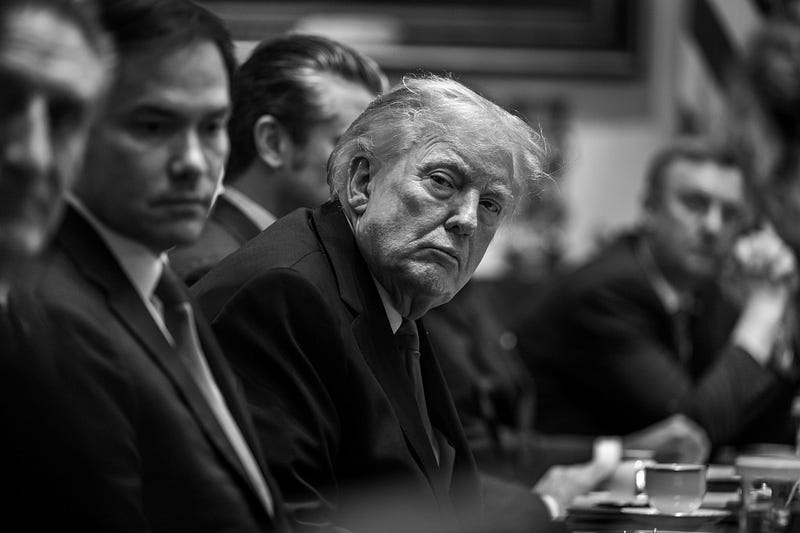
“Trump’s Armada Is Getting in Place. Now He Must Decide What to Do With Iran.”
The headline in the Wall Street Journal is stark, loaded with meaning, and open to all manner of interpretations.
“There have been discussions about a punishing bombing campaign that could topple Iran’s government, the officials said,” reported David S. Cloud and Alexander Ward for the WSJ. “Trump and his team have also weighed leveraging the threat of military force to extract diplomatic concessions from Iran.”
“What Trump decides will determine the shape of any military action,” mused Cloud and Ward.
The same question is occurring to everyone from Dubai to Washington. Mixed messages to the rulers of Iran seem to be order of the day from President Donald Trump. Is it a negotiating tactic or something more?
“Trump says he believes Iran wants to make a deal as he extols size of US ‘armada,’” reported diplomatic editor Patrick Wintour for the Guardian on Friday, adding the “US president declines to say whether he plans Venezuela-like operation, after Tehran signalled it was ready for talks.”
“We have a large armada, flotilla, call it whatever you want, heading toward Iran right now, even larger than what we had in Venezuela,” President Trump told the press. “Hopefully we’ll make a deal. If we do make a deal, that’s good. If we don’t make a deal, we’ll see what happens.”
The media landscape is filled to bursting with opinions about what the U.S. should do about Iran. Even conservative opinions are mixed.
“Stop thinking like it’s 2003 — toppling Iran’s mullahs does not risk mistakes of Iraq War,” advised Douglas Murray for the New York Post this week.
“People often ask me what I think President Trump is going to do about a particular issue,” mused Murray. “And I tend to say the same thing, whatever the subject: Look at what he has said he is going to do, and that is the thing he is most likely to do.”
“The Iranian people have risen up with incredible bravery against their tyrannical government,” he added. “President Trump has told the regime to stop the massacres of protestors, but the massacres go on. So it’s over to Trump.”
“How Many Times Do I Have to Write This Column About Iran? Regime change would still be a catastrophe, and it’s hard to see what the point of anything else is,” countered Jude Russo for The American Conservative with equal fervor.
“What are we actually going to do? The tea leaves are contradictory,” explained Russo. “On the one hand, it is not clear what the target would be, or what the provoking incident would be — in the sequel to the crackdown, Trump has downplayed reprisals and has largely stopped talking about Iran. The administration has shown a strong preference for making a very loud case for why high-profile military actions must be taken.”
The media is awash with fresh speculation today after reports that two mysterious blasts struck southern Iran early Saturday.
“Two explosions struck southern Iran on Saturday, one in Bandar Abbas and the other in Ahvaz, killing several people,” reported Iran International this morning. “The Revolutionary Guard denied reports that its Navy chief was killed in the blasts, while Israel rejected any involvement.”
“Iran’s President Masoud Pezeshkian said recent developments showed Donald Trump, Benjamin Netanyahu and European countries were seeking to provoke unrest and sow division,” Iran International explained.
“Decision-making circles in the United States and Israel have moved past diplomacy with Iran, viewing military action as effectively decided, with only the timing still under debate, a Western source familiar with coordination talks told Iran International,” the outlet added.
Over the next few days as the situation develops, the world will be waiting in breathless anticipation, united in the hope that freedom from tyranny may finally be within the grasp of Iran’s people.
(Contributing writer, Brooke Bell)